If you're planning a new agricultural or commercial building, one of the first decisions you'll need to make is the type of frame. Steel and timber are the two most common options, and both have their place -but for most agricultural and industrial applications, steel comes out on top. Here's a straightforward comparison to help you decide.
Steel Frame -The Advantages
Steel framed buildings have been the go-to choice for agricultural and industrial use for decades, and for good reason:
- Longer clear spans -steel portal frames can span much greater distances without internal columns, giving you more usable floor space. This is especially important for machinery storage and livestock buildings where you need room to manoeuvre.
- Strength and durability -steel doesn't rot, warp or twist over time. A well-built steel frame will last 50 years or more with minimal maintenance.
- Fire resistant -steel doesn't burn. While it can lose strength at very high temperatures, it won't contribute to a fire spreading -an important consideration when storing hay, straw or machinery.
- Pest proof -unlike timber, steel isn't affected by woodworm, rot or rodents.
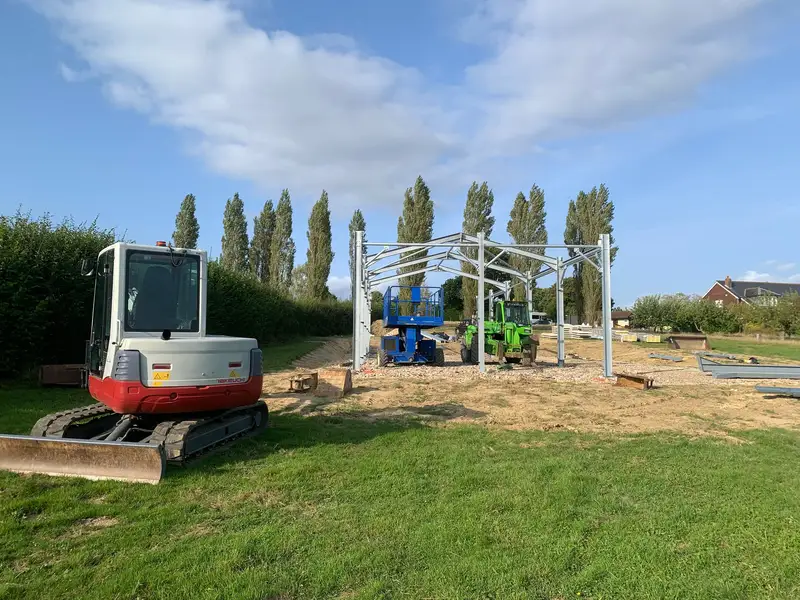
- Speed of erection -modern steel frames are fabricated off-site to exact specifications and bolted together on site. A typical agricultural building frame can be erected in a matter of days.
- Flexible and extendable -need to extend the building later? Steel frames are straightforward to add bays to, making future expansion much easier.
- Lower maintenance -once up, a steel frame building needs very little ongoing structural maintenance compared to timber.
Timber Frame -Where It Works
Timber frame buildings do have their place, particularly for smaller structures or where aesthetics are the priority:
- Smaller buildings -for garden buildings, small workshops or field shelters, timber can be a cost-effective option.
- Appearance -oak frame barns and timber structures have a traditional look that suits certain settings, especially in conservation areas or where planning requires a sympathetic design.
- DIY-friendly -smaller timber structures can be built with basic tools and carpentry skills.
However, timber does come with some drawbacks. It's susceptible to rot if not properly treated and maintained, it can be affected by pests, and larger spans require more complex engineering -often with internal columns that reduce usable space.
Cost Comparison
On a like-for-like basis, steel and timber frame buildings can be surprisingly close in cost for smaller structures. But as the building gets bigger, steel becomes increasingly cost-effective. The real savings with steel come from:
- Fewer internal supports needed (more usable space per square metre)
- Faster construction time (less labour cost)
- Lower long-term maintenance costs
- Longer lifespan before replacement is needed
When you factor in the full lifecycle cost -not just the build price -steel almost always works out cheaper for agricultural and industrial buildings.
Which Should You Choose?
For most agricultural storage, livestock, equestrian and commercial buildings, a steel frame is the better option. It gives you more space, lasts longer, and costs less to maintain over time.
Timber makes sense for smaller structures, traditional-style buildings, or where you specifically want that natural look -but for anything over about 6 metres wide, steel is usually the smarter choice.
If you're not sure which is right for your project, give us a call. We're happy to talk through your requirements and give you honest advice -there's no obligation and no hard sell.
Planning a new building?
Call Graham for free, honest advice on the best option for your project.